

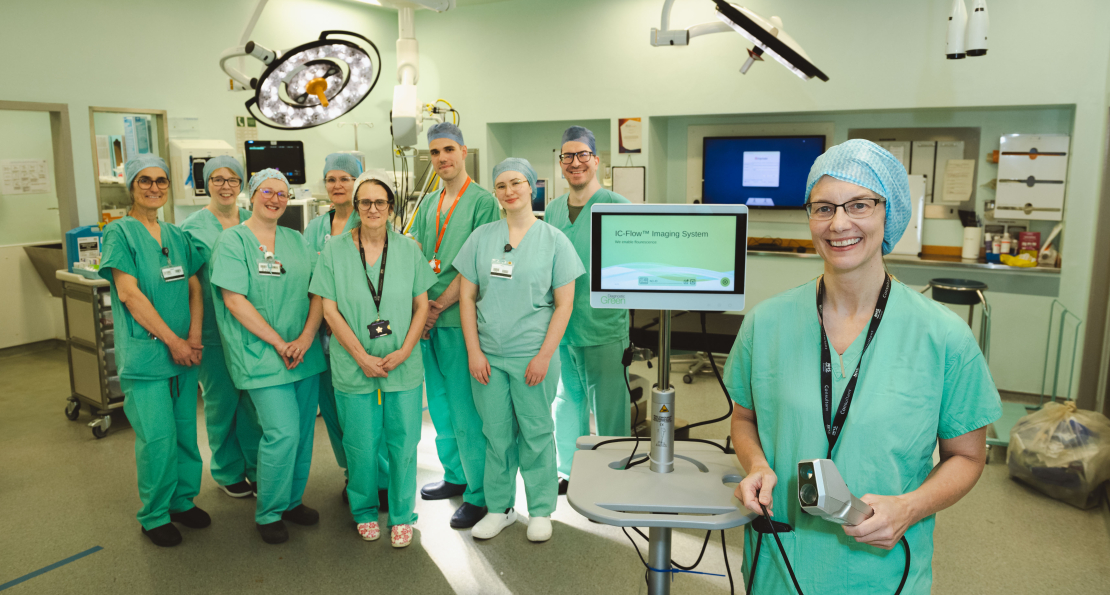
A new imaging system funded by Friends of ANCHOR is helping surgeons at ARI operate on early-stage breast cancers.
Miss Beatrix Elsberger, a consultant breast surgeon for NHS Grampian, is one of the medics using the new IC Flow imaging system, which Friends of ANCHOR funded at a cost of £36,500.
She said: “It is an enormous benefit to have this new equipment. It allows us to use a new method of surgery, which is a great alternative to the standard technique used to find the sentinel lymph node in early-stage breast cancer patients.”
During the standard technique, patients awaiting breast surgery have radioactive dye injected at the ARI Nuclear Medicine Department just before they come to theatre for their operation.
The injected dye travels from the breast to the lower armpit (axilla), where the sentinel lymph nodes are located. The dye means surgeons can find “gate keeper” lymph nodes to check that there has not been a spread of cancer cells from the breast into the armpit.
A recent shortage of radioactive dye, and the strict handling regulations in place for the material, limits these operations to theatres within Aberdeen Royal Infirmary.
Now though, by replacing the radioactive dye with immunofluorescent dye, surgeons have the option to perform these procedures on a day-case basis both within ARI and in other centres.
Beatrix said: “Thanks to this equipment we don’t have to rely on radioactive dye, which means that in the future we’ll have the option to move some of these straightforward cancer operations to Stracathro Hospital.”
Stracathro Hospital, a small district facility near Brechin, is a Regional Treatment Centre dedicated to a high volume of day-case operations. By booking suitable patients in for surgery at Stracathro, Beatrix says we could see waiting times come down:
“From an operating point, this new imaging camera has improved our flexibility within the breast services team, enabling us to use an additional theatre facility, which has the potential to help reduce surgery waiting time for our breast cancer patients.
“Many breast units in the UK and worldwide need to move away from the standard technique because of variable obstacles.
“We are very pleased to have Friends of ANCHOR’s support in enabling NHS Grampian to follow suit as demand on resources and facilities is on the rise due to more early detections of cancer.”
Patients who meet the criteria for the new method will have a fluorescent dye injected ahead of their operation. The IC Flow imaging tool easily picks up the bright green colour of the dye as it moves through the lymphatic system to signal the location of the sentinel lymph node in the armpit.
“We are not interested in resecting random lymph nodes,” explained Beatrix.
“We want to identify the correct first lymph node that the breast cancer could have spread into. By removing and analysing this lymph node we gain valuable information, which helps us build an individualised treatment plan for the patient after surgery.
“We have a very dedicated and caring breast theatre team at ARI, and they go above and beyond in their roles. We are fortunate to have a fantastic group of individuals who are fully supportive of new methods and who will always do what they can do keep pushing forward to find new and better ways of caring for our patients.”